Reversing Roots of Pacha (Kickstarter Codes)
Motivation
A while back I backed Roots of Pacha on Kickstarter, a prehistoric farming sim made by the indie studio SodaGen. I ended up with two copies of the game.
As a backer I was supposed to get a set of exclusive unlock codes, but I only received the most basic one, the one matching the tier I pledged for. What caught my eye was that both copies gave me the exact same code, which meant one thing:
the codes are static per reward tier, not per player or per copy.
That single detail was enough to get my gamer greed going. If the codes don’t depend on who you are, maybe there’s a way to see what the higher tiers look like without paying for them. So I opened the game up to find out, and this post walks through what I found.
Tools
First step: grab ILSpy, a cross-platform .NET decompiler. It needs the .NET Desktop Runtime 6.0.16 installed alongside it, so get that too.
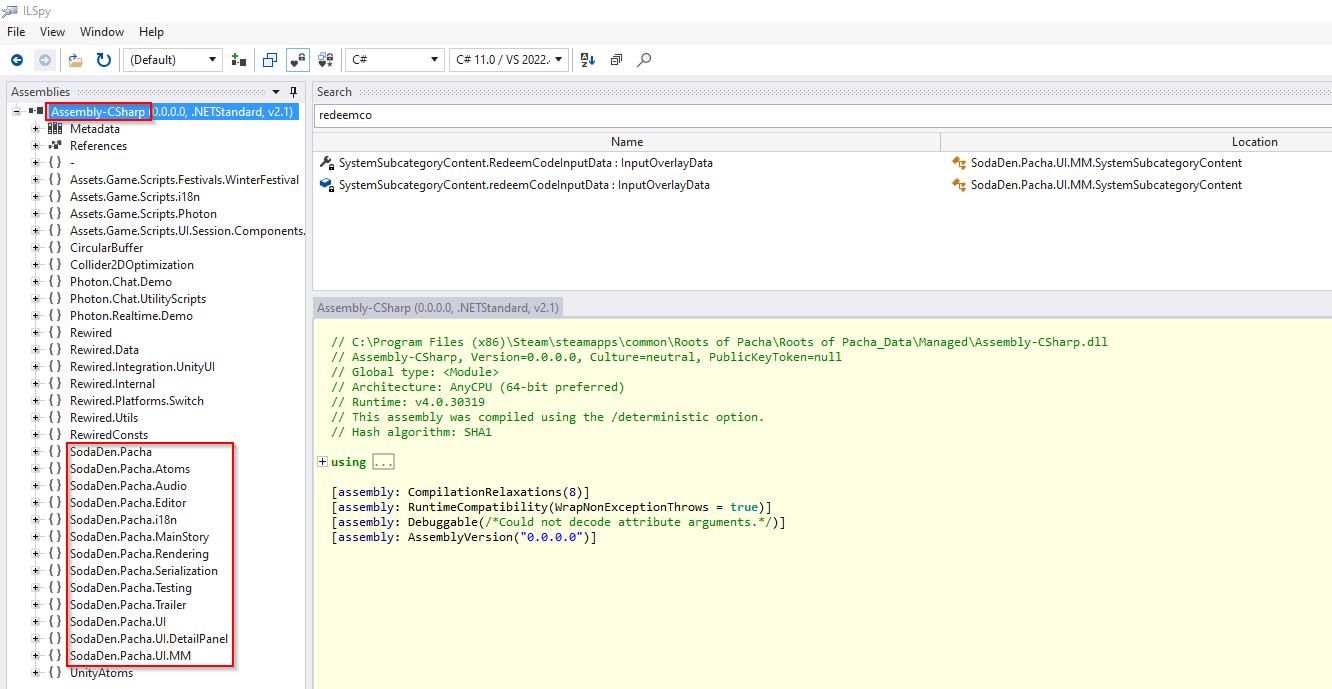
Once both are in place, load Assembly-CSharp.dll into ILSpy. On a Steam install you’ll find it under %ProgramFiles(x86)%\Steam\steamapps\Roots of Pacha\Roots of Pacha_Data.
Studying the code
Looking for gold
With the assembly loaded, I started searching for the obvious keywords: key, code, redeem. That turned up a static class named RedeemableCodes, holding what looked like base64-encoded strings.
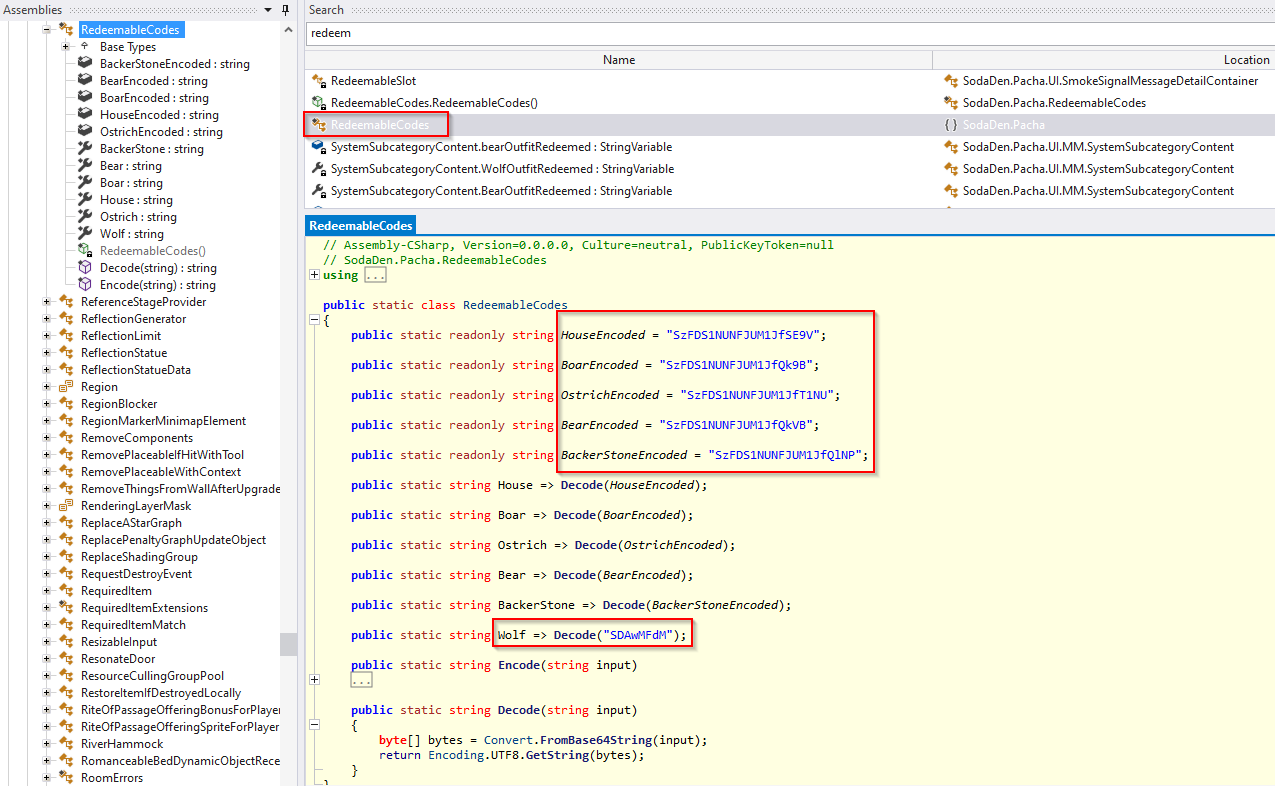
Decoding them gave this:
public static readonly string HouseEncoded = "SzFDS1NUNFJUM1JfSE9V"; // K1CKST4RT3R_HOU
public static readonly string BoarEncoded = "SzFDS1NUNFJUM1JfQk9B"; // K1CKST4RT3R_BOA
public static readonly string OstrichEncoded = "SzFDS1NUNFJUM1JfT1NU"; // K1CKST4RT3R_OST
public static readonly string BearEncoded = "SzFDS1NUNFJUM1JfQkVB"; // K1CKST4RT3R_BEA
public static readonly string BackerStoneEncoded = "SzFDS1NUNFJUM1JfQlNP"; // K1CKST4RT3R_BSO
Promising, except none of these match the XXXX-XXXX-XXXX-XXXX format the real Kickstarter codes use, and none of them work in-game either. Dead end, or so it seemed.
Hardcoding is my life
While going through the rest of RedeemableCodes, one entry stood out because it was declared differently from the others, and its decoded value didn’t follow the K1CKST4RT3R_ naming pattern at all.
public static string Wolf => Decode("SDAwMFdM"); // H000WLOut of curiosity more than expectation, I typed H000WL into the game’s code redemption screen. And it worked.
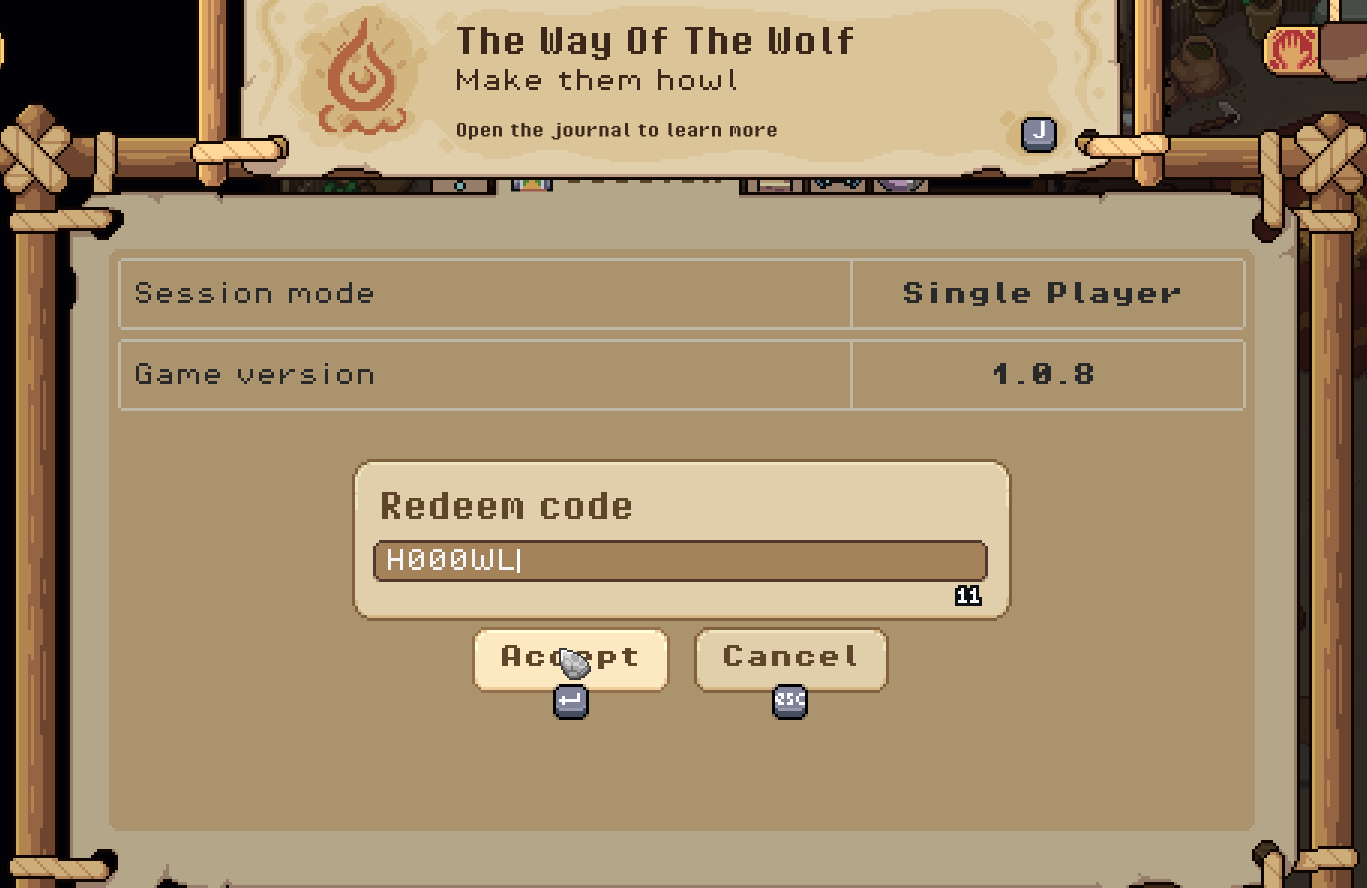
That code unlocks a wolf skin, similar to Okka. Small win, but a real one.
A bitter end
Curious why this one code behaved differently, I used ILSpy’s Analyze feature (Ctrl+R) to trace every place RedeemableCodes gets referenced.
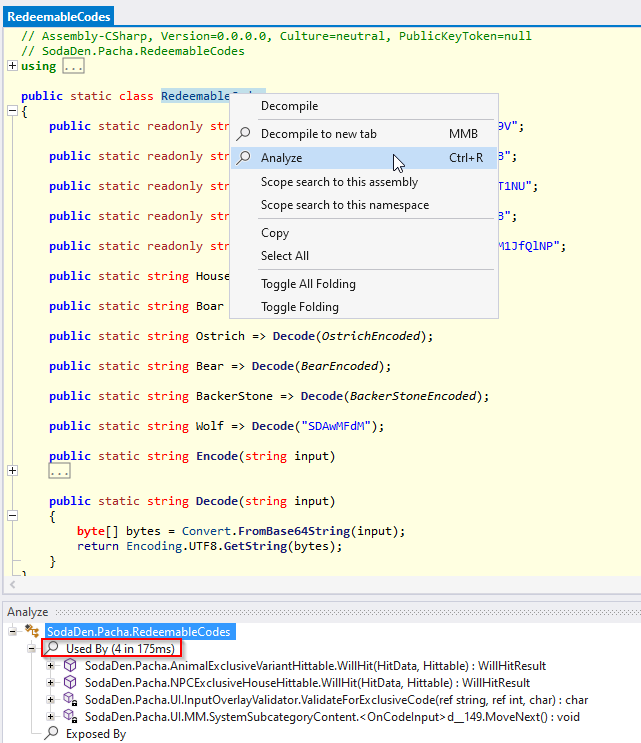
That led to MoveNext, inside SodaDen.Pacha.UI.MM.SystemSubcategoryContent.<OnCodeInput>d__149. The relevant check looks like this:
<error>5__5 = false;
<invalidCode>5__6 = false;
<codeResult>5__7 = null;
if (result == RedeemableCodes.Wolf)
{
    <codeResult>5__7 = "Wolf";
    goto IL_0400;
}
<webRequest>5__8 = UnityWebRequest.Get("https://us-central1-roots-of-pacha-pledgebox.cloudfunctions.net/orders/validate-code?code=" + result.Replace("-", ""));
goto IL_02b0;
And there’s the answer: Wolf is the only code checked locally, with a plain string comparison. Every other code gets sent off to an API for validation. I poked at that endpoint a bit, and a bogus code returns a 400 Bad Request:
GET /orders/orders/validate-code?code=11111111111111111111 HTTP/2
Host: us-central1-roots-of-pacha-pledgebox.cloudfunctions.net
User-Agent: Roots of Pacha/RE
Accept: */*
HTTP/2 400
x-powered-by: Express
vary: Origin
content-type: text/plain; charset=utf-8
etag: W/"b-EFiDB1U+dmqzx9Mo2UjcZ1SJPO8"
function-execution-id: dzp46qom6e3i
x-cloud-trace-context: 00dcb74056fb9e32b8b25a6811903c73;o=1
date: Thu, 04 May 2023 14:33:31 GMT
server: Google Frontend
content-length: 11
alt-svc: h3=":443"; ma=2592000,h3-29=":443"; ma=2592000
Bad RequestA valid code, on the other hand, comes back with an identifier that gets picked up by the same MoveNext method:
GET /orders/orders/validate-code?code=<REDACTED> HTTP/2
Host: us-central1-roots-of-pacha-pledgebox.cloudfunctions.net
User-Agent: Roots of Pacha/RE
Accept: */*
HTTP/2 200
x-powered-by: Express
vary: Origin
content-type: text/html; charset=utf-8
etag: W/"c-axJCePMEBUBMGYDipb7BeNjTSIg"
function-execution-id: xjaf1wrdjzs0
x-cloud-trace-context: 3a0ad57b00afc686ac7535a264c7cc4b;o=1
date: Thu, 04 May 2023 14:38:46 GMT
server: Google Frontend
content-length: 12
alt-svc: h3=":443"; ma=2592000,h3-29=":443"; ma=2592000
Backer_StoneAnd that’s where the trail runs cold. Each code is 12 alphanumeric characters, which is roughly 4.7 quintillion combinations, and only a handful of those are actually valid.
Brute-forcing that endpoint isn’t just impractical, it would also mean attacking a server I have no authorization to touch. Not something I’m willing to do, and not something I’d suggest either.
Conclusion
Walking away with one extra code wasn’t the jackpot I was hoping for, but it wasn’t nothing either. RedeemableCodes.Wolf clearly got wired up differently from the rest, most likely something thrown in last-minute without going through the same validation path. Lucky for me it happened to be checkable client-side.
I might come back to this at some point. Getting every reward is still tempting, and I’ve since noticed other promotions tied to the game’s demo build that don’t seem to work on the current version. That’s a rabbit hole for another day.